Surgical Sutures: Types, Materials, Sizes and Uses
A surgical suture is a sterile thread, usually attached to a needle, used to close wounds and surgical incisions, tie off blood vessels and hold tissue together while it heals. Choosing the right suture depends on the tissue, the healing time, the risk of infection and the surgeon's preference. This guide explains the main types of sutures, common materials, sizes, needle types and the instruments used for suturing.
Absorbable vs Non-Absorbable Sutures
Sutures are divided into two main groups. Absorbable sutures are gradually broken down by the body (by enzymes or hydrolysis), so they do not usually need to be removed. They are used for deeper tissues and internal layers. Non-absorbable sutures stay in place permanently or are removed after the wound heals. They are commonly used for skin, tendons, vessels and tissues that heal slowly.
Common Absorbable Sutures
| Suture | Material / structure | Typical features | Common uses |
|---|---|---|---|
| Plain gut | Natural (purified animal intestine) | Loses strength within about 7 to 10 days | Fast-healing tissue, mucosa |
| Chromic gut | Natural gut treated with chromium salts | Lasts longer than plain gut, roughly 10 to 14 days or more | Gynaecological and general soft tissue |
| Polyglactin 910 (Vicryl) | Synthetic, braided | Holds for about 2 to 3 weeks; absorbed in about 2 months | Subcutaneous tissue, general closure, ligation |
| Poliglecaprone 25 (Monocryl) | Synthetic, monofilament | Loses strength in about 1 to 2 weeks; absorbed in about 3 to 4 months | Subcuticular skin closure, soft tissue |
| Polydioxanone (PDS) | Synthetic, monofilament | Holds for about 4 to 6 weeks; absorbed in about 6 months | Fascia, abdominal wall, slow-healing tissue |
Times are approximate and vary with the suture size, the tissue and the patient, so manufacturer data should always be checked.
Common Non-Absorbable Sutures
- Silk: a natural braided suture with excellent handling and knot security. It is classed as non-absorbable, although it slowly loses strength over time.
- Nylon: a synthetic monofilament commonly used for skin closure.
- Polypropylene (Prolene): a smooth monofilament with low tissue reaction, widely used in vascular and cardiac surgery.
- Polyester (for example Ethibond): a strong braided suture used in cardiovascular and orthopaedic work.
- Stainless steel wire: very strong, used for sternum closure and bone repair.
Monofilament vs Braided Sutures
- Monofilament: a single smooth strand. It passes easily through tissue and is less likely to harbour bacteria, but it can be stiffer and needs more throws for secure knots.
- Braided (multifilament): several strands woven together. It handles well and holds knots securely, but the spaces between strands can harbour bacteria, so it is generally avoided in contaminated wounds.
Suture Sizes (USP)
Suture thickness follows the USP scale. The more zeros in the number, the finer the thread. For example, 6-0 (also written 6/0) is much thinner than 3-0, and sizes without zeros such as 1 or 2 are thicker.
- Very fine (6-0, 5-0): delicate areas such as the face and fine vessel work.
- Medium (4-0, 3-0): commonly used for skin and soft tissue.
- Heavier (2-0, 0, 1): deeper layers, fascia and tissue under tension.
These are general examples. The exact choice is made by the surgeon for each procedure.
Suture Needles
Most surgical needles are curved and swaged (attached) to the thread. Needles differ in point type, curvature and size.
- Cutting needles: have a sharp cutting edge and are used for tough tissue such as skin. Reverse cutting needles have the cutting edge on the outer curve.
- Taper (round-bodied) needles: pass between tissue fibres without cutting and are used for softer tissue such as bowel, fascia and vessels.
- Blunt needles: used for friable organs such as the liver or kidney.
- Curvature: 3/8 circle and 1/2 circle needles are the most common.
Common Suturing Techniques
- Simple interrupted: each stitch is tied separately, which gives control and allows individual stitch removal.
- Simple continuous (running): a single thread runs along the wound, which is quicker.
- Mattress sutures (vertical or horizontal): used for wound edge eversion and for closing under tension.
- Subcuticular: placed in the layer just below the skin surface, often using an absorbable monofilament, for a neat cosmetic result.
Instruments Used for Suturing
- Needle holder: holds the curved needle firmly. The Mayo-Hegar type is the most common, and Olsen-Hegar combines a needle holder with scissors.
- Tissue forceps: such as Adson forceps, to hold the tissue edge while the needle passes. See our guide to Allis tissue forceps for heavier tissue handling.
- Suture scissors: to cut the thread after knotting or to remove stitches.
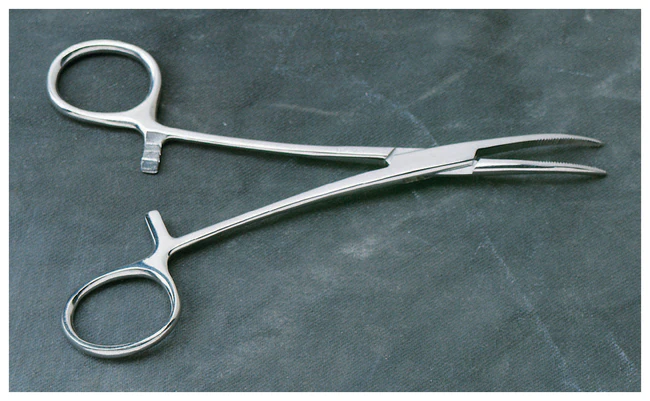
- Hemostatic forceps: to control bleeding before closure and to hold suture ends. Read Hemostatic Forceps: Types, Uses and How to Use Them.
A hemostat should not be used in place of a needle holder, as its serrations can damage the needle and thread. For an overview of all instrument groups, see Surgical Instruments Names and Uses.
Alternatives to Sutures
Depending on the wound, clinicians may use skin staples, tissue adhesive (skin glue) or adhesive strips instead of, or together with, sutures. The choice depends on the location, tension and depth of the wound.
Frequently Asked Questions
What are the two main types of surgical sutures?
Absorbable sutures, which the body gradually breaks down, and non-absorbable sutures, which stay in the tissue or are removed after healing.
What does suture size 3-0 or 4-0 mean?
It is the USP size. The more zeros, the finer the thread, so 6-0 is thinner than 3-0. Sizes without zeros, such as 1 or 2, are thicker.
What is the difference between monofilament and braided sutures?
Monofilament is a single smooth strand with less bacterial wicking. Braided is woven from several strands, with better handling and knot security but a higher chance of harbouring bacteria.
What is the difference between cutting and taper needles?
Cutting needles have a sharp edge for tough tissue such as skin. Taper needles pass between tissue fibres without cutting and are used for softer tissue.
Which instrument is used to hold a suture needle?
A needle holder (needle driver), such as the Mayo-Hegar type, used together with tissue forceps and suture scissors.
Conclusion
The right suture depends on the tissue, the healing time and the risk of infection, and the right instruments make suturing precise and safe. Sutures are only one part of the set: a good quality needle holder, forceps and scissors are just as important. Explore our needle holders and hemostatic forceps made in Sialkot, Pakistan, or contact us for bulk orders and quotations.
Note: This article is for general educational purposes. Suture selection and wound care must be decided by a qualified healthcare professional, and manufacturer instructions for use should always be followed.